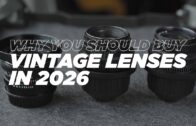

If you are a filmmaker, owning at least one set of vintage lenses is almost a necessity in 2026. In the past, shooting with old lenses might have made people assume you couldn’t afford modern cinema glass. Today, that perception has completely changed. Vintage and cinemodded lenses are now widely embraced by professional filmmakers because they offer character, texture, and a truly filmic look that modern lenses often lack.
The Shift Away From Clinical Lenses
For years, lenses were reviewed almost exclusively on sharpness, especially corner-to-corner sharpness. Now we live in an era where lenses are optically perfect, but often boring. These modern lenses are frequently described as clinical: extremely sharp, contrasty, and sterile.
That’s why we’re seeing major productions move toward rehoused vintage lenses, such as the IronGlass lenses used on The Batman and Dune Part II. Filmmakers are intentionally choosing lenses with imperfections because those flaws add emotion and personality to the image.
Cinematographers Don’t Care About Corner Sharpness
Ask yourself: how often do you really look at the corners of a movie frame? Most of the time, the edges are already out of focus. With today’s ultra-high-resolution digital cameras, images have become too sharp, resulting in what many associate with an overly digital look.
To counter this, filmmakers now rely on mist filters, diffusion filters, and lens tuning systems to soften images and reduce digital harshness. Ironically, these tools are simply recreating the natural flaws found in vintage lenses such as softness, swirly bokeh, chromatic aberration, and lower contrast.
Instead of spending thousands on filters and tuning systems, you can often buy an entire set of vintage lenses for less and get those organic characteristics natively.
Vintage Lenses Are Still Affordable (For Now)
One of the biggest advantages of vintage lenses is affordability. Lesser-known brands like Pentacon, Panagor, and many others still offer incredible value. However, this won’t last forever.
Canon FD lenses are a perfect example. They were once extremely cheap, but many models are now rare and expensive sometimes costing as much as new lenses. The same trend has already happened with Russian lenses. Today’s inexpensive vintage lens could become tomorrow’s collectible.
Buying vintage lenses now isn’t just a creative choice it can also be a smart investment. Many filmmakers later resell their lenses at a profit.
Easily Adaptable to Mirrorless Cameras
Most vintage lenses can be adapted to nearly all mirrorless mounts, including Sony E, Canon RF, Nikon Z, and L-mount, using affordable adapters. This means you can switch camera brands without replacing your entire lens collection.
Modern mirrorless lenses don’t offer this flexibility. Changing camera systems often forces you to sell your lenses and reinvest something vintage lenses help you avoid.
Vintage Lenses Outlast Camera Bodies
Camera bodies come and go, but vintage lenses are built to last. Many are fully mechanical, made of metal, and designed to be serviced easily. Some vintage lenses are over 70 years old and still produce stunning images today.
I’ve owned several vintage lenses for more than 14 years while cycling through nearly 10 different cameras. With no electronics inside, there are fewer components that can fail, making vintage lenses incredibly reliable long-term tools.
Autofocus Is Coming to Vintage Lenses
Most vintage lenses are manual focus, but that’s changing. Affordable LiDAR autofocus systems from companies like DJI and PDMovie already allow filmmakers to add autofocus to manual lenses.
Looking ahead to 2026, new autofocus adapters from brands like Tilta and Viltrox are expected to use the camera’s PDAF (phase-detect autofocus) system. Unlike LiDAR, which struggles in bright environments, these upcoming solutions promise higher accuracy and better performance—bringing modern autofocus to classic glass.
Vintage Lenses and the Future of Medium Format
The future of cinema cameras is clearly moving toward larger sensors and medium format. With more medium-format cinema cameras entering the market, an interesting discovery has emerged: many vintage full-frame lenses actually cover medium-format sensors.
Some Russian lenses, such as the Helios 44-2, and several Nikon vintage lenses already provide sufficient image coverage. In contrast, many modern full-frame lenses are designed to cover only full frame.
This means your vintage lens set could be future-proof, ready for medium-format cameras once they become more accessible.
Final Thoughts: Why Vintage Lenses Make Sense in 2026
Vintage lenses offer character, longevity, adaptability, affordability, and future potential, all things modern lenses often struggle to deliver. Whether you’re a filmmaker looking for a unique visual style or a creator investing in gear that holds its value, vintage lenses are one of the smartest choices you can make in 2026.


